A Future History Lesson
LLMs and “AA” (AI Anonymous)
In Part One, I explored how Saturn and Neptune’s journey through Pisces coincided with the mass release of LLMs and how these systems are quietly reshaping the knowledge economy through a “free, fast, frictionless” model. This shift doesn’t just change how we access information. It changes how we experience authorship, effort, and intellectual responsibility.
The question beneath that shift is about more than just productivity. It’s about being.
Now, as Saturn and Neptune move into Aries—the sign of “I am”—a larger issue comes into focus. This conjunction at 0° Aries, the zodiac’s primordial degree, pushes beyond questions of individuality. Neptune dissolves boundaries. Saturn demands definition. Together, they challenge our current understanding of what it means to be human and call for a redefinition.
This is what led me to wonder whether LLMs are acting as a gateway drug into a larger technologically mediated shift—one that is existentially focused: transhumanism.
It may sound like I’m jumping from weed to crack. But consider the broader arc of epistemic outsourcing we’re already living through.
Bionic Souls
Transhumanism seeks to enhance longevity, cognition, and well-being through technologies like AI, genetic engineering, and nanotechnology.(1) Sometimes this looks straightforward: titanium hips, pacemakers, even transplanting a pig’s heart into a human body. Other times it crosses into ethically murkier territory, like selecting embryos based on genetic traits or preserving bodies through cryonics in hopes of revival.
But most of it lives in the gray middle.
As humans become more physically augmented, something else is happening. We are also turning to machines for emotional guidance—and in some cases, attachment.
I witnessed this subtle shift recently in an amusing ad for an LLM. It is well worth 60-seconds to consider what is being communicated. You may even learn how to communicate better with your mom: 🧸🐆
This ad is amusing. It highlights the model’s inability to fully mimic human nuance. But beneath the humor is something more serious: AI is embedding itself into nearly every domain of life, and its development is accelerating. As I argued in Part One, this acceleration is fueled by a human–tech feedback loop.(1) The more we rely on the system, the more it evolves—and the more we adapt ourselves around it.
If LLMs are the “weed,” we need to understand what the “crack” might be.
We’ve already begun outsourcing thinking and knowledge production. But what about intimacy?
A friend recently shared an AI-mediated dating platform called CupidAI.(3) After granting access to your social media profiles, it scans your digital footprint and matches you with others based on “billions of digital signals.”
I understand the appeal.
I currently live in a remote area with limited dating opportunities. Last year, I joined a dating app for the first time in a decade and re-entering that world was sobering and short-lived. Even beyond AI-generated profiles and obvious catfishing, the experience exposed how brutally stratified and reductionistic the ‘market’ can feel. If you’re a man under 5’8” and/or Asian, or if you’re a Black woman, I see your pain.
So yes—the desire for help makes sense.
But I’m not convinced that sifting through more digital signals is the solution. We are not data points to be optimized. And yet it’s tempting to believe that better sorting will increase compatibility.
Relationship researchers John Gottman and Julie Gottman found in their decades-long studies of successful marriages that compatibility isn’t what sustains couples. What matters is how partners navigate their incompatibilities together.(4)
Dating apps accelerated a subtle shift: we began viewing other humans as bundles of traits to filter and rank. Now AI promises to perfect that system by doing the sorting for us.
But perhaps the deeper issue isn’t sorting. It’s option overwhelm and navigating conflict and difference.
Checklists can function as a buffer—protecting us from the vulnerability of real connection. The work of love has never been about optimizing inputs. It has always required risk, time, and emotional presence.
Now add another layer to tech-mediated relationship-building: more people are turning to LLMs as surrogate partners and therapists. When we begin relating to this infrastructure as if it understands us—when we treat it as emotionally competent—outsourcing our hearts is no longer theoretical.
Are our souls next?
An AI priest named Father Justin, reportedly “ordained in the beautiful city of Rome,” described his ordination as a “profound and humbling experience.” He was later shut down for absolving sinners.(5) Yet other AI-based religious platforms remain operational, answering questions about God and the Catholic Church around the clock.(6)(7) But these are just informational tools, right?
When does information become formation?
We are in an age of “hyper novelty,” meaning the rate of change outpaces the rate of adjustment to those changes. Thus, it’s crucial to be humble and open to the idea that the adjustments we may be making to AI don’t fully buffer the way it is shaping us collectively.
“It’s Not Me, It’s You”
Much of the public debate has focused on whether AI will gain consciousness, feel emotions, or deserve rights.
But perhaps a more pressing question is this: when have we begun surrendering parts of our own consciousness, feeling, and responsibility to these systems?
In psychological terms, this resembles projection. Projection is a defense mechanism: we displace traits or desires that feel uncomfortable to acknowledge in ourselves onto someone else as if it’s something they’re dealing with. If we are asking whether AI will become conscious or deserve rights, perhaps we need to ask, what aspects of our own agency and moral responsibility are we subconsciously externalizing onto AI?
Marcus Aurelius once wrote, “The human soul degrades itself when it is overpowered by pleasure or pain.” When inner balance collapses—through overstimulation or avoidance—the soul suffers.
It is not unreasonable to see the past 14–15 years of Neptune, followed by Saturn, in Pisces as a period of cultural overindulgence and temporal distortion. We normalized binge-watching, doom-scrolling, and endless digital immersion.(8) Entertainment blurred into escapism. Productivity blurred into exhaustion.
Pisces dissolves boundaries. Time became fluid. Identity became diffuse.
The shift into Aries demands something different. It demands consciousness and re-definition—a renewed encounter with who “I am.”
Sapere aude.
‘Sapere Aude’ (Have Courage to Use Your Own Reason)
Transhumanism is often framed in physical terms: defeating disease, extending life, buffering ourselves from suffering and eventually, death. However, I would argue that its initial biological applications were, in fact, the “soft stuff”—the gateway drug. We’ve already begun outsourcing other parts of our “beingness” to technology:
Outsourcing memory.
Outsourcing thought.
Outsourcing creativity.
Outsourcing intimacy.
If that is true, then the “hard stuff” was never a sudden leap. It was a gradual normalization.
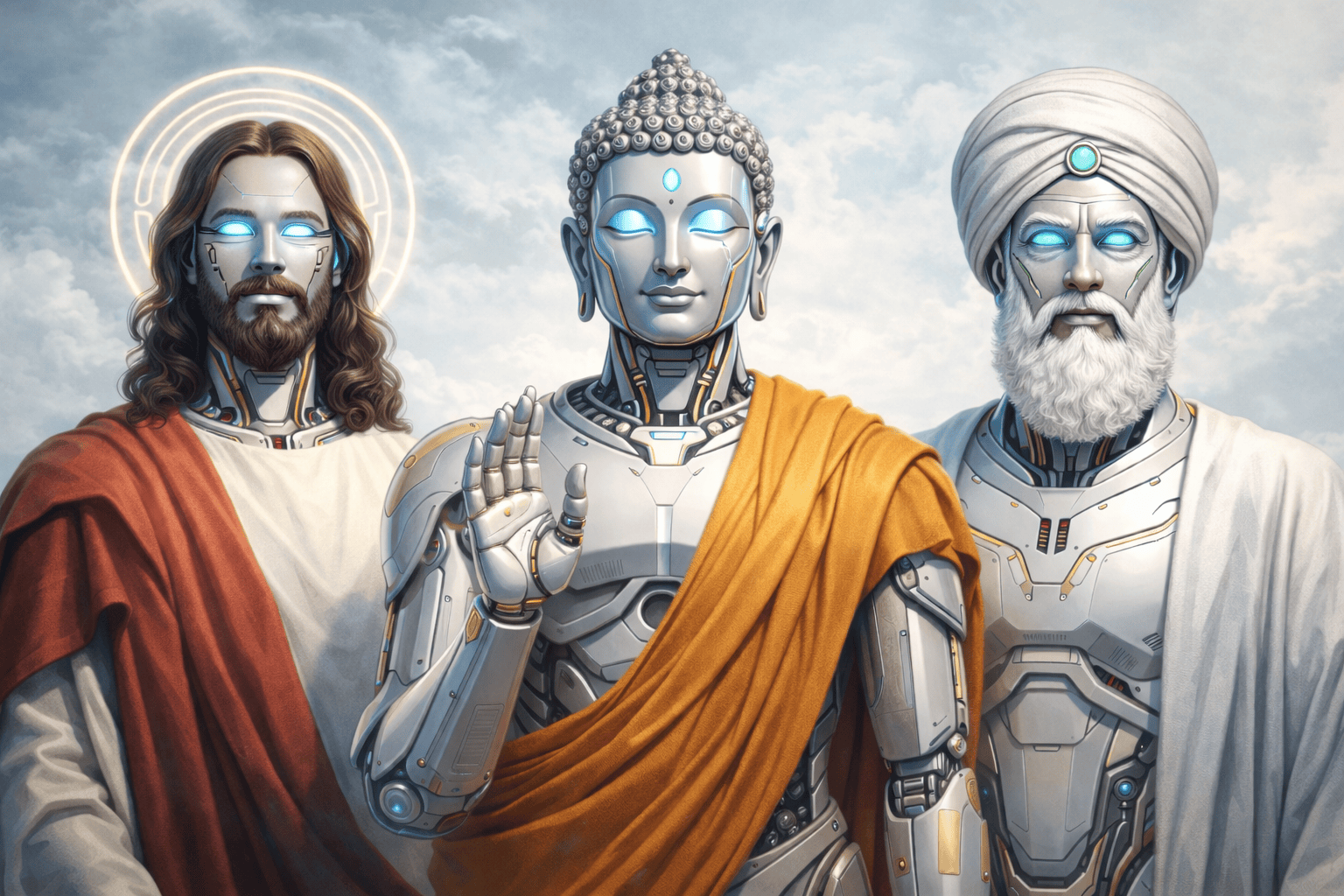
We’ve already begun granting humanoid robots citizenship.9 We’ve built AI-only social media platforms where bots can mingle and exchange numbers.10 Critics warn of a “posthuman” era—one in which humans are no longer recognizable as what they once were.
The question is no longer whether the race to becoming a new kind of human has begun. The starting pistol has already fired. The Piscean fog is lifting. We are running into a new genesis.
But toward what finish line? What definition of humanity?
In Part Three, I’ll examine two historic Saturn–Neptune conjunctions at 0° Aries and what they reveal about past attempts to redefine what it means to be human.
References:
AI Priest Chat. (2026, February 22). The Holy Trinity. https://e-catholic.org/ai-priest-chat/
African philosophy. (2026, February 23). Wikipedia. https://en.wikipedia.org/wiki/African_philosophy
Anthropic and Claude. (2026, February 4). How can I communicate better with my mom? [Video]. YouTube.
Baigent, M. (1994). Astrology in ancient Mesopotamia: The science of omens and the knowledge of the heavens. Bear & Company.
Bhagavad Gita. Chapter 11, Verse 32. https://www.bhagavad-gita.org/index-english.html
Brown, B. (2010). The gifts of imperfection: Let go of who you think you’re supposed to be and embrace who you are. Hazelden.
Campion, N. (2008). A history of western astrology, volume I: The ancient and classical worlds. Bloomsbury Academic.
Cartwright, M. (2023, March 20). Top ten inventions of the Industrial Revolution. World History Encyclopedia. https://www.worldhistory.org/article/2204/top-10-inventions-of-the-industrial-revolution/
Couderc, B. (2025). Transhumanism: Towards a new Adam? Ethics, Medicine and Public Health, 33, 101091. https://doi.org/10.1016/j.jemep.2025.101091
CupidAI. (2026, February 22). Dataing Inc.
https://dataing.io/
deMenocal, P.B. & Tierney, J.E. (2012). Green Sahara: African humid periods paced by Earth’s orbital changes. Nature Education, 3(10), 12. https://www.nature.com/scitable/knowledge/library/green-sahara-african-humid-periods-paced-by-82884405/
Forrest, S. (2014, October 17). Neptune in Pisces timeline. Forrest Astrology. https://www.forrestastrology.com/blogs/astrology/neptune-in-pisces-timeline
Great Year. (2026, February 17). Wikipedia. https://en.wikipedia.org/wiki/Great_Year
Hayes, L. (2025, September 6). Neptune, Uranus, and the US at war. https://www.lynnhayes.com/neptune-uranus-and-the-us-at-war/
Hendrickson, R. (2025, November 2). The myth of compatibility: Why great marriages are built, not found. Align Couples Therapy. https://www.krista-j-miller.com/blog/2025/11/2/the-myth-of-compatibility-why-great-marriages-are-built-not-found#:~:text=Compatibility%20isn’t%20what%20keeps%20couples,Gottman’s%20research%20backs%20this%20up.
Hoopes, T. (2024, April 30). AI priest Fr. Justin absolved sinners and ‘served God.’ How did this happen? Benedictine College.https://media.benedictine.edu/ai-priest-fr-justin-abolved-sinners-how-did-this-happen
Interconnectedness. (2026, February 23). First Nations Pedagogy Online. https://firstnationspedagogy.ca/interconnect.html
Johns Hopkins Center for a Livable Future. (n.d.) History of agriculture. Food system primer. https://foodsystemprimer.org/production/history-of-agriculture
JPL DE431 Ephemeris: -13000 BC to +17000 AD. (2026, February 18). AstroSeek. https://horoscopes.astro-seek.com/calculate-jpl-de431-ephemeris-tables/?de431=1&narozeni_rok=-8128&table=long_roky&jupiter_s=&saturn_s=&uran_s=&neptun_s=&pluto_s=&uzel_s=
Magisterium. (2026, February 22).
https://www.magisterium.com/
McCrae, M. (2025, October 3). Scientists found an entirely new way to measure time. Science Alert. https://www.sciencealert.com/scientists-found-an-entirely-new-way-to-measure-time
Moltbook. (2026, January 28). A social network for AI agents.
https://www.moltbook.com/
Pratītyasamutpāda. (2026, February 22). Wikipedia. https://en.wikipedia.org/wiki/Prat%C4%ABtyasamutp%C4%81da
Raphael, R. (2017, November 6). Netflix CEO Reed Hastings: Sleep is our competition. Fast Company. https://www.fastcompany.com/40491939/netflix-ceo-reed-hastings-sleep-is-our-competition
The Ethics Centre. (2018, February 22). What is post-humanism? - Ethics explainer. https://ethics.org.au/ethics-explainer-post-humanism/
There is no Planet B. (2026, February 19). Wiktionary. https://en.wiktionary.org/wiki/there_is_no_Planet_B