A Pre-History Lesson
“To be, or not to be, that is the question:
Whether ‘tis nobler in the mind to suffer
The slings and arrows of outrageous fortune,
Or to take arms against a sea of troubles
And by opposing end them.”
– William Shakespeare, Hamlet
Hamlet’s Dilemma
Hamlet asked his famous question as an individual. But sometimes history asks it of an entire species:
What does it mean to be “alive?” What constitutes a person? What makes us a conscious species deserving of the title “wise man” (homo= man; sapiens = knowing or wise)?
These are not small existential questions. And yet they are exactly the questions being mirrored now through the fusion of Saturn and Neptune in Aries—the sign of “I am”—at the very beginning of the zodiac.
Their conjunction on February 20, 2026 at 0° Aries marks an important moment. But it also signals a much larger story that has been unfolding for a long time.
Neptune dissolves boundaries. Saturn builds structures. When these two archetypes meet in Aries, they can provoke Hamlet-like questions about what it means “to be”—not just as individuals, but as human beings. They ask us to redefine who “I am.”
But when this conjunction occurs at 0° Aries—the world axis—the scope becomes far larger. The question expands from the identity of the individual to the identity of the species. What does it mean for homo sapiens “to be”?
As I mentioned in Part One, I do not believe it is an overstatement to call this a “Genesis Moment.”
And now that I’ve framed this current quality of time with no small amount of gravitas, I will add this: we’ve been here before.
Humanity has approached this threshold in the past and made decisions about what it means to be human—both individually and collectively. Those decisions reshaped our relationship to one another and to the Earth itself.
When did those decisions occur?
Here is a clue: every species is defined by its relationship with its ecosystem.
In this series, we have already explored a present-day existential quandary involving LLMs and a future-oriented question of “becoming” and the role transhumanism is playing. Now, in Parts Three and Four, we turn to the past—first to prehistory and then to early recorded history—to examine how humanity has answered these questions before.
For now, we begin at the beginning.
A Pre-History Lesson
Most Saturn–Neptune conjunctions do not occur at the birthing point of the zodiac.
In fact, determining whether this alignment had ever occurred at 0° Aries required a fair amount of research(1) and calculation to determine whether this alignment had ever occurred at 0° Aries in recorded history. As it turns out, it has not happened in “recorded” history—but it has occurred twice in prehistory, with the second instance occurring at 0°01’ Aries! (A detailed explanation of these calculations appears in the footnotes for those who enjoy celestial math.)(2)
These two dates are August of 8128 BCE and January of 4360 BCE. That’s it. No Saturn-Neptune conjunctions at 0° Aries for the last 6,400 years. You may be thinking, “That’s interesting…but what can we possibly learn from a moment that far back in time?” It turns out, quite a lot.
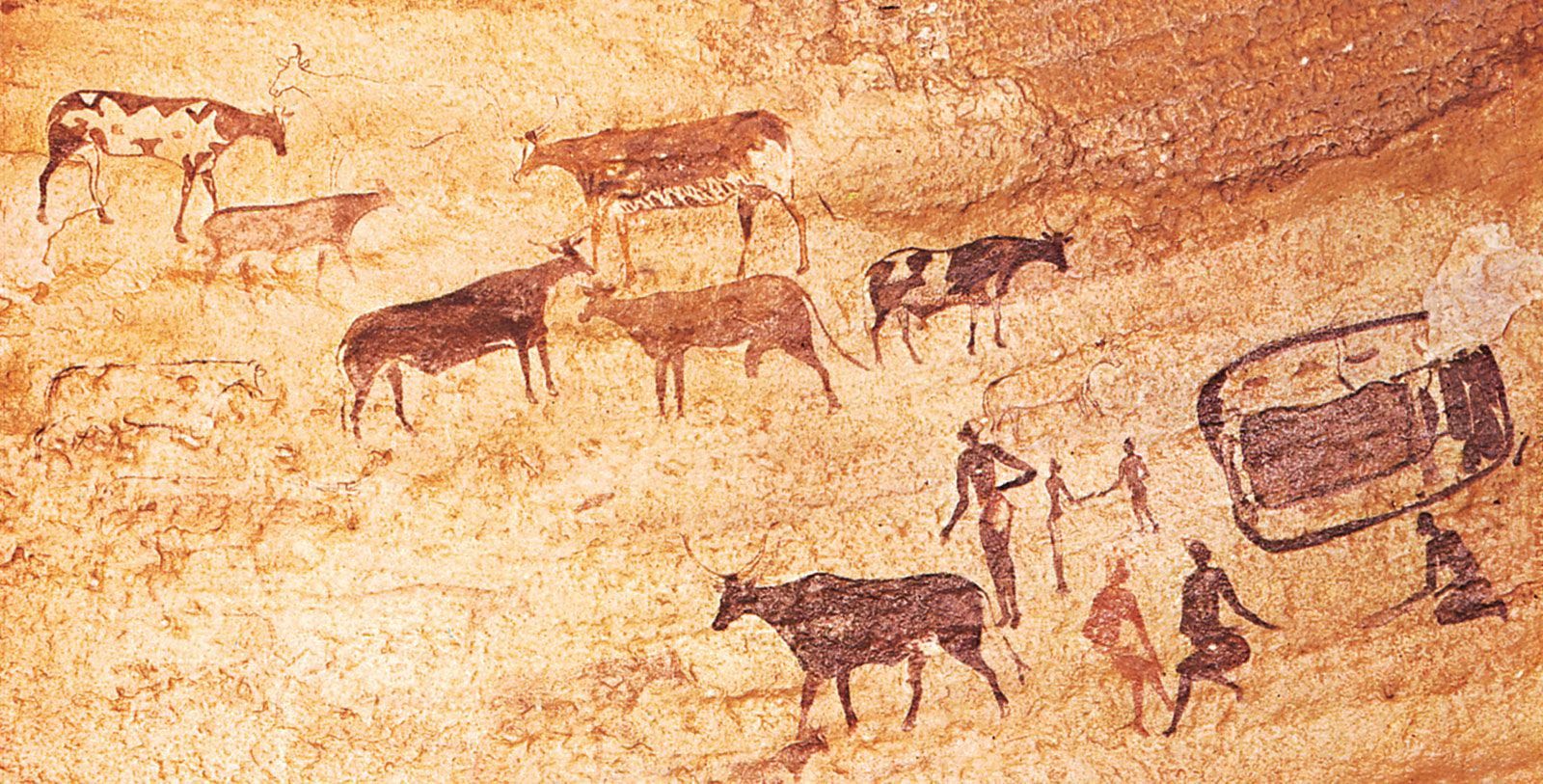
The Neolithic Revolution, occurring roughly between 10,000 and 8,000 BCE, marked one of the most significant transitions in human history. It is commonly described as the shift from hunter-gatherer societies to agricultural ones following the end of the Ice Age.
Some scholars, particularly supporters of the Younger Dryas Impact Theory, argue that this period may also represent recovery after the collapse of earlier and possibly more technologically sophisticated cultures. Regardless of which interpretation proves correct, one fact remains clear: the Earth was changing, and humanity adapted.
Drivers of this adaptation included dramatic climate change and population pressures. By around 8,000 BCE, melting ice sheets in the North Atlantic began flooding the region between Britain, Denmark, and the northern European coast. This process eventually submerged a landmass now known as Dogger Land, displacing entire populations and compressing communities into smaller areas.(3)
Environmental instability also increased the need for reliable food sources.
In response to this, some of the earliest urban settlements in Mesopotamia, such as Çatalhöyük in central Turkey and Jericho,(4) eventually began experimenting with domesticated plants. These early agricultural “technologies” required human intervention to grow and propagate, gradually reshaping daily life.(5)
Does climate change and the impact of changing technologies sound familiar?
Humanity’s relationship to food, daily life, social organization, and the Earth itself shifted toward a new agricultural paradigm. I would argue our present revolution is no less seismic. But it is also dynamically connected to that earlier shift 10,000-12,000 years ago. To understand why, we must first understand the Great Year.
The Great Year
Every 72 years, the sidereal vernal equinox shifts approximately 1° earlier in the zodiac (for example, shifting from 0° Aries to 29° Pisces and onward towards 6° Pisces where it is today). This essentially means that over long periods of time, the first day of spring slowly moves backward through the signs. This phenomenon is called the precession of the equinoxes and it takes approximately 25,772 years to complete a full 360° cycle. Astrologers often refer to this cycle as the Great Year.
If we treat the Saturn-Neptune conjunction at 0° Aries in 8128 BCE as a symbolic starting point within that 25,772-year cycle—not an absolute beginning, but a meaningful point within it—we are now approaching its halfway point, or its 180° opposition.
In other words, we may be standing halfway through a civilizational experiment that began thousands of years ago.
In astrology, oppositions are dynamic and are sometimes described as a crisis point of culmination. They represent tension between initial impulse and maturation, or between origin and outcome. They can create friction but also catalytic change if needed. If 8128 BCE marked the archetypal “birth” of an agrarian identity or rebuilding from a more technologically sophisticated culture, then the present moment signals a reckoning with the development of that identity.
About 10,000–12,000 years ago, we chose to become a species that cultivated the earth, building communities after climatic upheaval. In saying, “Let’s all pitch our tent here,” we created social roles. Some cultivated, some hunted, some guarded, some innovated. Our homes changed. Our rhythms changed. Our relationships changed. Our relationship to the Earth changed.
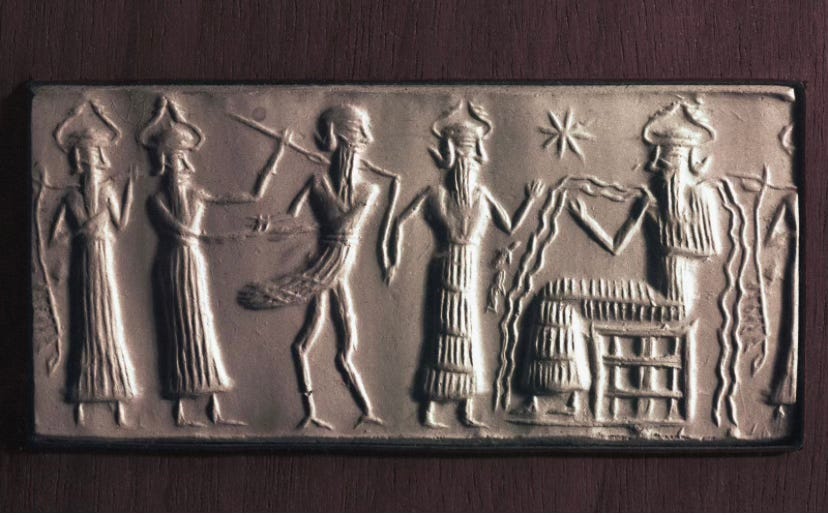
It does not take an astrologer, sociologist, or environmentalist to see that we’ve made quite a mess. Perhaps it does take a comedian like Rob Newman to point out, “There is no Planet B.”(6) So now what?
Do we clean up our mess and try again? Do we double down? Do we wait for consequences? At one of the largest turning points in a vast cycle of time, humanity is being asked to reflect on its identity as a species on Earth:
Are we here to live—or to consume?
Are we like a virus—or a participant in balance?
Are we capable of playing well with others?
January 4360 BCE: The Growth of Communal Spiritual Identities
Nearly 4,000 years later, the Earth shifted again.
During the African Humid Period of 4500-4000 BCE, the Sahara transformed again due to the Earth’s wobble—stemming from that same long-term precessional movement of the Earth. What was once grasslands, lakes and rivers, and an otherwise habitable savanna became a scorching desert. Weakened monsoon patterns gradually dried arable land.(7)
Climate once again reshaped identity.
As a result of this symbolic shift from wet and cool Pisces to hot and dry Aries, African humans migrated toward the Nile Valley, laying foundations for Egyptian civilization. Trade networks expanded and predynastic Egyptian burial sites began to reflect social differentiation.
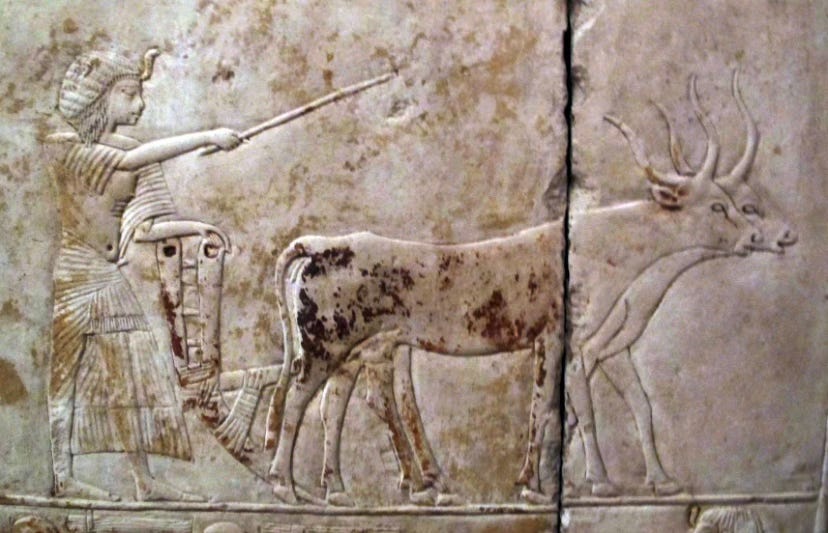
It shouldn’t be a surprise then that evidence of mother-goddess worship appears as early as 6750 BCE at sites such as Jarmo. Small statues of pregnant women have been found there in large numbers, suggesting that each household contained at least one example of this fertility-centric awareness.(8)
During the later Ubaid period, these households began organizing themselves into communities with religious centers. For example, the famous ziggurat at Eridu—dating to around 2100 BCE—was built atop seventeen earlier temple structures. Archaeological layers show that the site had been used continuously for ritual purposes as far back as 5000 BCE.(9)
Elsewhere, in the Negev Desert, archaeologists have uncovered a complex oriented toward the four cardinal directions with a designated area of worship facing the setting sun. It dates to roughly 4700–4200 BCE—one again, close to the second Saturn–Neptune conjunction at 0° Aries.(10)
Together, these examples suggest that communities were increasingly organizing themselves around shared spiritual identities.
Environmental change had once again catalyzed social, technological, and spiritual reorganization.
Choosing Between Car Accidents or a Bat
It is striking that Saturn-Neptune conjunctions at 0° Aries have occurred only twice in roughly 10,000 years. One might expect more data for such an important point in the zodiac. Yet the rarity of these alignments makes their coincidence with major shifts in human identity difficult to ignore.
Many of the structures that shaped our species’ development emerged during these earlier periods: agriculture, technology, hierarchy, and organized spirituality.
Only recently have we begun growing food in labs, developing technologies capable of planetary destruction, or attempting to leave Earth entirely. Along the way, we have used social stratification and religion both to organize society and dominate one another.
But it’s easy to critique the trajectory of our species without looking at oneself.
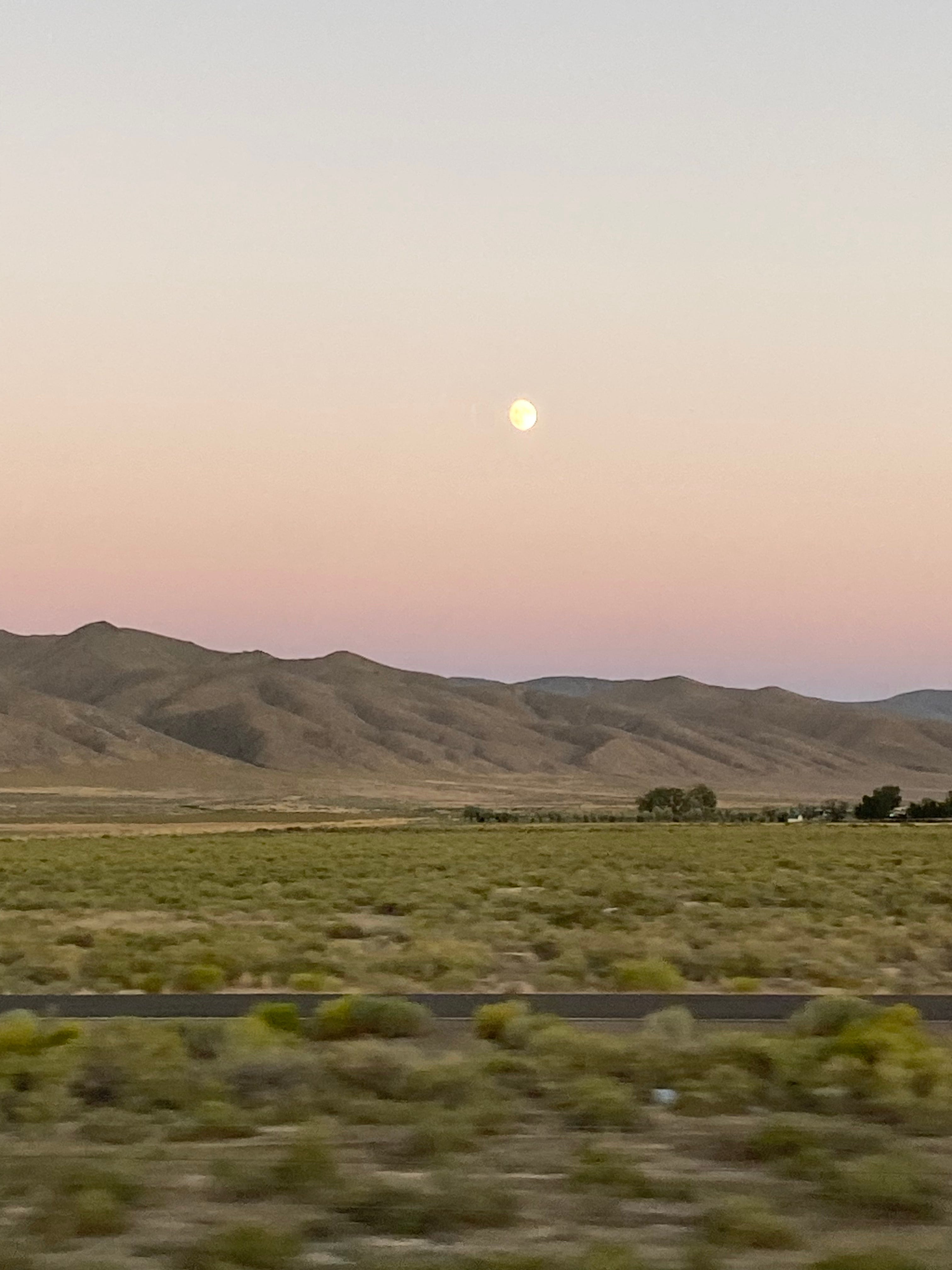 Image taken on my cross-country departure from city to rural life
I remember vividly driving away from my home of almost nine years in a major city. My apartment was only a few blocks from a highway, which meant a constant soundtrack of screeching tires, crashes, and sirens. I didn’t realize how much subconscious stress this had placed on my body until I was about twenty minutes outside the city and noticed something startling: silence.
Green fields stretched out before me, an optic oasis for desert-stricken eyes. In that moment it became clear how de-centered I had become from the biological relationship between the Earth and my body’s natural rhythms and needs.
But the story doesn’t end there.
I went to stay with some family in an agricultural community. My family grows their own food and stores it for the winter, and is generally, very attuned to the land. However, this shift to a more ecologically attuned place was also a racially and religiously homogeneous community. After a while, I began to notice another startling sensation: social and spiritual silence. I felt a protective turning inward. In a religious community where even Lutherans are sometimes suspected of not being Christian (forget about Catholics), my identity as an astrologer, a non-literal interpreter of scripture, and an open theologian quickly marked me as suspect. I stopped going to social events and limited conversations about spirituality.
It was a desert of a different kind and I was parched for meaningful connection.
Against my better judgment, I attended a church service with a family member. I won’t recount what was preached that day, because my intention is not to disparage Christianity. In fact, there are many thoughtful people doing important work to reinterpret it in meaningful ways.
But the personal fallout of that ninety minutes startled me once again. For three days afterward I felt physically and spiritually depleted—nauseous, fatigue, depressed, unable to eat. My social and spiritual “body” felt so disoriented that it reacted almost like a physical illness. In retrospect, I should have taken the bat that had somehow gotten into the church and was warming itself midday by an illuminated cross behind the pulpit as an omen.
In response to that event, I found myself longing for my former home in the city—where open-minded and curious people were easier to find, and where I could feel more free to be myself.
But in that nostalgia I briefly forgot the other costs. I was out of balance and was looking for equilibrium, even if it was in a place where I had been de-centered in another form. There came a moment when I realized that swapping forms of disconnection wouldn’t lead to the centeredness I was seeking.
How often do we do this—swapping an imbalanced relationship for technological dissociation, or belief in something larger than ourselves for total self-sufficiency?
I don’t yet know whether there is a place that perfectly resolves this dilemma for me personally. What I do know is that oscillating between different states of ecological, social, and spiritual imbalance does not lead to a centered identity. A whole human life requires a deeper center: going beyond a place and toward a state of being.
This raises a broader question: how have we collectively de-centered ourselves?
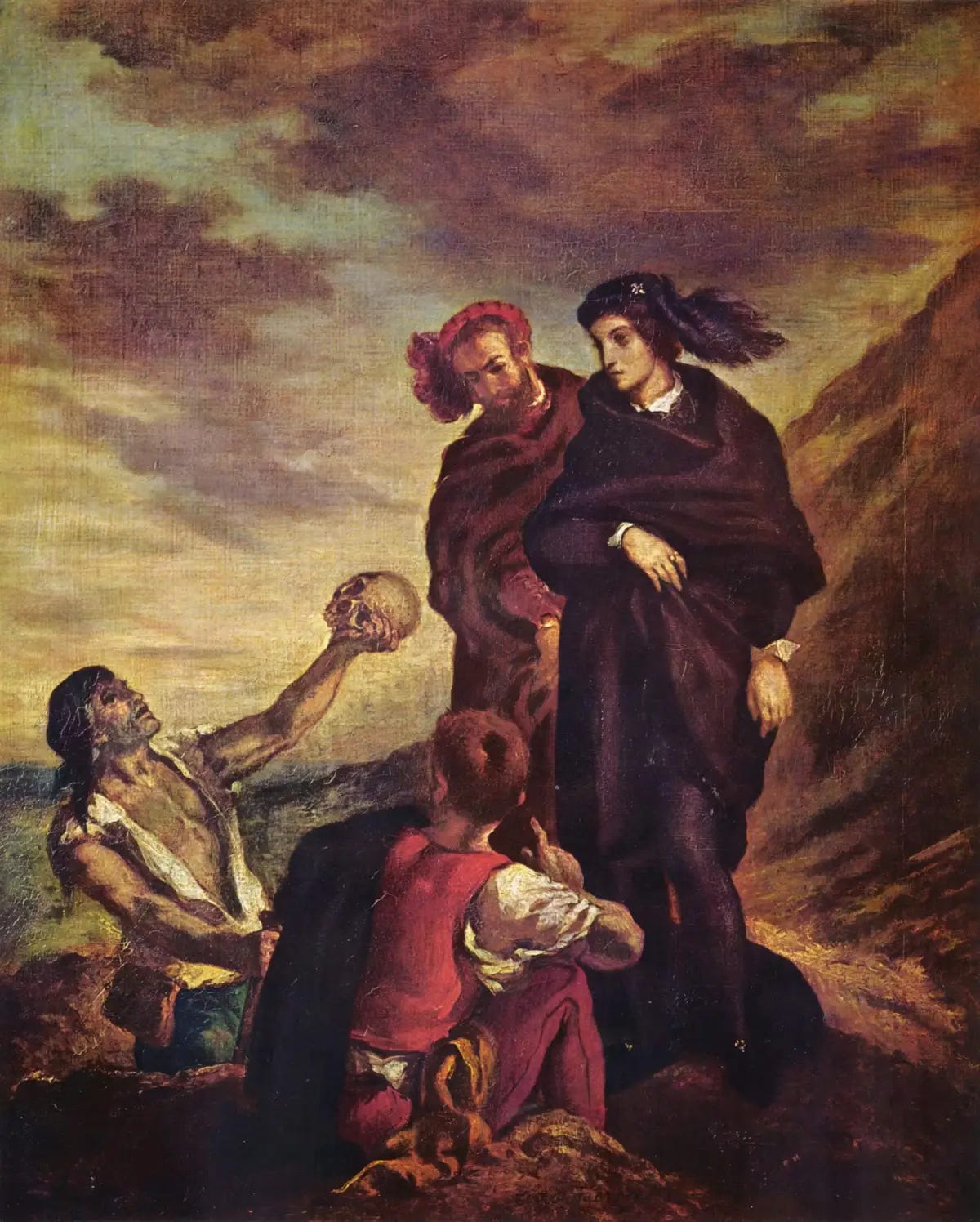 Eugene Delacroix: Hamlet and Horatio in the Garden (1839)
From Hamlet to Lord Krishna
At times, our trajectory appears driven by an unconscious impulse to evolve beyond agricultural rhythms, technological responsibility, social morality, or even a Supreme Being. Are we redefining our species as homo insipiens (i.e. “unwise man”)?
Perhaps the next iteration of humanity involves colonizing Mars. Or perhaps if we have “recovered” from a lost technologically sophisticated culture, then maybe extraterrestrials could be our mythic mirror—or even a distant evolutionary cousin of a species that once outgrew its own habitat without learning how to care for it or for themselves. (If that turns out to be true, I am perfectly content with my body fertilizing the soil here. You all can go ahead.)
Returning to our mother, Gaia metaphor, I imagine her stepping back into the room and asking us:
“What on Earth are you doing in here?!”
And an honest answer echos back the voice of Oppenheimer:
“Now I am become Death, the destroyer of worlds.”(11)
At its most basic level, being human means living in relationship with our habitat—not in opposition to it.
Whether we remember that may determine what kind of species we become.
In Part Four, we will turn to a more modern historical lesson to explore how Saturn-Neptune conjunctions in Aries have shaped our evolving answers to the question of who “I am” within our social and spiritual identities.
I used the JPL DE431 ephemeral database from AstroSeek to locate dates in which both Saturn and Neptune were in Aries. The table does not provide daily motion, but does provide each planets’ position on the 1st of every month. Starting from the oldest date available in the database (13000 BCE) and working through to the present, I searched for instances when both planets were at 0°, or could have been at 0° at some point in the month. This process resulted in two dates, at which point I needed to note where each planet was in its direct / retrograde cycle so that planetary speed could be factored in.
August 8128 BCE:
I was able to ascertain fairly easily that the 8128 BCE date qualified. You can see in the ephemeris that both planets entered Aries in May, turned retrograde in July, and returned to Pisces in September. Their planetary speeds were therefore moving quite slowly around their stations in July which was around 2°20’ Aries for Saturn and 1°21’ Aries for Neptune.
By August 1st, Neptune had reached 1°04’R and had not yet reached full retrograde speed. However, it would not have taken more than a few days for Neptune to retrograde 0°05’ and reach the 0°59’ Aries threshold. By August 1st, Saturn had reached 1°55’ and by September 1st, had reached 0°03’.
CONCLUSION: Given Saturn was at 0°03’R on September 1st, exact calculations to the arc minute are not necessary to deduce that during the end of the month of August, retrograde Saturn made a conjunction with retrograde Neptune at 0° Aries before Saturn passed Neptune and returned to Pisces in early September.
January 4360 BCE:
The 4360 BCE conjunction occurred exceptionally close to the Pisces/Aries cusp and therefore required additional calculations and identifying the approximate planetary speed during those months. While we do not know the exact days these planets turned direct, as synchronicity would have it, the present day 2026 positions of Saturn and Neptune are not only at similar degrees but also similar speeds within their retrograde to direct motion cycles. (It is worth noting that Neptune’s orbit is not perfectly circular but instead, slightly elliptical, meaning that it moves faster when it is closer to the Sun. Since we are comparing dates that cover a very long time span, this is worth mentioning. However, when it is closer to the Sun its change in speed is very minute. I do not know where in its orbit it was on either of these dates. However, Neptune has a relatively low planetary eccentricity (deviation from a perfect circle) of 0.008, whereas Earth in comparison has an eccentricity range from 0.06 to 0.005. Therefore its unknown point in its ellipses should not affect the calculations enough within a 30-day window of time. Nevertheless, my calculations are naturally imperfect given the variety of factors I was not able to calculate for.)
We can see that in December of 4361, both Saturn and Neptune stationed direct at the end of Pisces. Since Saturn had passed Neptune by February 1, 4360 BCE, I needed to ascertain at what degree and minute they were conjunct during the month of January, and during a period of time when they were still picking up speed. Between January 1st 4360 BCE at 27°50’ Pisces and February 1st at 0°28’ Aries, Saturn moved 2°38’ (or 158 arc minutes) in a 30-day period. In the present day, Saturn has also recently turned direct in the last couple days of November 2025. Using the same noon ephemeris from AstroSeek as the JPL DE431, I can see that Saturn has the same daily rate of motion post-stationing direct in 2026, moving 2°38’ (or 158 minutes) in a 30-day periodbetween January 5, 2026 (26°25’ Pisces) and February 5, 2026 (29°03’ Pisces). This means that on average, Saturn moved 5.2666 arc minutes per day, both in 4360 BCE and 2026 CE. Because Saturn is picking up speed in both cases, it is actually slightly less than 5.2666 minutes per day at the start of the 30-day window and slightly more than 5.2666 minutes per day at the end of the 30-day window, but I’ll return to this factor when we discuss Neptune later.
Next, I want to find out approximately what day and time Saturn hit 0°00’ Aries in 4360 BCE. I know that it was at 0°28’ on February 1st, 4360 BCE and that its daily rate of motion was at roughly 5.2666 minutes per day. This means that Saturn traveled 0°28’ and hit 0°00’ Aries 5.317 days before February 1st at noon (285.2666=5.317 days or 5 days and ~8 hours). This is the early morning / ~4-5 AM of January 27th, 4360 BCE.Using the present day ephemeris, I can verify visually and mathematically that this calculation works. In 2026, Saturn is at a similar point of acceleration in direct motion as it was in 4360 BCE: At noon on February 5, 2026, Saturn was at 29°03’ Pisces. And 5.317 days prior, on January 31, 2026 around 4-5 AM, Saturn was at 28°25’ Pisces. This 2026 calculation is the same 5.2666 minutes per day—or 0°28’ difference over 5.317 days—as in 4360 BCE. Therefore, I can say with at least a certain amount of confidence that this 4360 BCE date and approximate time isn’t far off.
As for Neptune, between January 1st, 4360 BCE at 29°30’ Pisces and February 1st, 4360 BCE at 0°08’ Aries, Neptune moved 0°38’ in a 30-day period. This is a rate of speed of 1.2666 arc minutes per day (38 divided by 30="1.2666)." I want to find out approximately what day and time Neptune hit 0°00’ Aries in 4360 BCE. I know that it was at 0°08’ on February 1st at noon, 4360 BCE and that its daily rate of motion was at roughly 1.2666 minutes per day. This means that Neptune hit 0°00’ Aries 6.316 days before February 1st at noon (81.2666=6.316 days or 6 days and ~8 hours), which is the early morning / ~4-5 AM of January 26th, 4360 BCE.
Using the present day noon ephemeris, I can see that Neptune was also at the same exact 29°30’ Pisces on January 1st, 2026 and 0°08’ Aries on February 1st, 2026 and therefore at roughly the same daily rate of motion of 1.2666 minutes per day. Again, Neptune had recently turned direct and was picking up speed in both cases, meaning it was actually slightly less than 1.2666 minutes per day at the start of the 30-day window and slightly more than 1.2666 minutes per day at the end of the 30-day window. I can verify visually and mathematically in the noon ephemeris that on January 26th, 2026—6 days prior to February 1st—Neptune in fact ingressed into Aries, but the question is at what time and what the rate of difference is from the date and time we found in 4360 BCE.
By using the same ephemeris method as above, I can see that Neptune ingressed sometime after noon on the 26th and before noon on the 27th, 2026. I can verify more minutely with astrological software that Neptune was actually at 0°00’ Aries on January 26, 2026 at 5:35 PM UTC, which is 5 days 18 hours 25 minutes—or 5.7674 days—before February 1st at noon—a difference of 0.5486 days (6.316 days in BCE - 5.7674 days in 2026 = 0.5486 days difference)—or roughly 13 hours and 10 minutes different. Given my projection of 4-5 AM on January 26th in 4360 BCE and the astrological software’s verification of 5:35 PM on January 26th in 2026 CE using similar (but not identical) rates of speed for a Neptune that has recently turned direct but is not yet at full speed, I therefore need to factor in at least a 13-14 hour buffer to account for rounding and changes in Neptune’s speed at different points in the month. This will help me deduce if they were in fact conjunct at 29°59’ Pisces or 0°00’+ Aries in 4360 BCE.
CONCLUSION: Given Saturn’s calculated ingress into Aries at ~4-5 AM of January 27th, 4360 BCE and Neptune’s calculated ingress into Aries between ~4-5 AM of January 26th and 5-7 PM of January 26th, 4360 BCE, this tells us that Neptune likely entered Aries before Saturn (just like in 2026). Therefore, Saturn ingressed into Aries, caught up with Neptune, and was conjunct just barely after the Aries ingress. Factoring in an additional 24 hours of movement into Aries for Neptune, Saturn was likely conjunct Neptune around 0°01’ or possibly 0°02’ on January 27th, 4360 BCE.
References:
AI Priest Chat. (2026, February 22). The Holy Trinity. https://e-catholic.org/ai-priest-chat/
African philosophy. (2026, February 23). Wikipedia. https://en.wikipedia.org/wiki/African_philosophy
Anthropic and Claude. (2026, February 4). How can I communicate better with my mom? [Video]. YouTube.
Baigent, M. (1994). Astrology in ancient Mesopotamia: The science of omens and the knowledge of the heavens. Bear & Company.
Bhagavad Gita. Chapter 11, Verse 32. https://www.bhagavad-gita.org/index-english.html
Brown, B. (2010). The gifts of imperfection: Let go of who you think you’re supposed to be and embrace who you are. Hazelden.
Campion, N. (2008). A history of western astrology, volume I: The ancient and classical worlds. Bloomsbury Academic.
Cartwright, M. (2023, March 20). Top ten inventions of the Industrial Revolution. World History Encyclopedia. https://www.worldhistory.org/article/2204/top-10-inventions-of-the-industrial-revolution/
Couderc, B. (2025). Transhumanism: Towards a new Adam? Ethics, Medicine and Public Health, 33, 101091. https://doi.org/10.1016/j.jemep.2025.101091
CupidAI. (2026, February 22). Dataing Inc.
https://dataing.io/
deMenocal, P.B. & Tierney, J.E. (2012). Green Sahara: African humid periods paced by Earth’s orbital changes. Nature Education, 3(10), 12. https://www.nature.com/scitable/knowledge/library/green-sahara-african-humid-periods-paced-by-82884405/
Forrest, S. (2014, October 17). Neptune in Pisces timeline. Forrest Astrology. https://www.forrestastrology.com/blogs/astrology/neptune-in-pisces-timeline
Great Year. (2026, February 17). Wikipedia. https://en.wikipedia.org/wiki/Great_Year
Hayes, L. (2025, September 6). Neptune, Uranus, and the US at war. https://www.lynnhayes.com/neptune-uranus-and-the-us-at-war/
Hendrickson, R. (2025, November 2). The myth of compatibility: Why great marriages are built, not found. Align Couples Therapy. https://www.krista-j-miller.com/blog/2025/11/2/the-myth-of-compatibility-why-great-marriages-are-built-not-found#:~:text=Compatibility%20isn’t%20what%20keeps%20couples,Gottman’s%20research%20backs%20this%20up.
Hoopes, T. (2024, April 30). AI priest Fr. Justin absolved sinners and ‘served God.’ How did this happen? Benedictine College.https://media.benedictine.edu/ai-priest-fr-justin-abolved-sinners-how-did-this-happen
Interconnectedness. (2026, February 23). First Nations Pedagogy Online. https://firstnationspedagogy.ca/interconnect.html
Johns Hopkins Center for a Livable Future. (n.d.) History of agriculture. Food system primer. https://foodsystemprimer.org/production/history-of-agriculture
JPL DE431 Ephemeris: -13000 BC to +17000 AD. (2026, February 18). AstroSeek. https://horoscopes.astro-seek.com/calculate-jpl-de431-ephemeris-tables/?de431=1&narozeni_rok=-8128&table=long_roky&jupiter_s=&saturn_s=&uran_s=&neptun_s=&pluto_s=&uzel_s=
Magisterium. (2026, February 22).
https://www.magisterium.com
McCrae, M. (2025, October 3). Scientists found an entirely new way to measure time. Science Alert. https://www.sciencealert.com/scientists-found-an-entirely-new-way-to-measure-time
Moltbook. (2026, January 28). A social network for AI agents.
https://www.moltbook.com/
Pratītyasamutpāda. (2026, February 22). Wikipedia. https://en.wikipedia.org/wiki/Prat%C4%ABtyasamutp%C4%81da
Raphael, R. (2017, November 6). Netflix CEO Reed Hastings: Sleep is our competition. Fast Company. https://www.fastcompany.com/40491939/netflix-ceo-reed-hastings-sleep-is-our-competition
The Ethics Centre. (2018, February 22). What is post-humanism? - Ethics explainer. https://ethics.org.au/ethics-explainer-post-humanism/
There is no Planet B. (2026, February 19). Wiktionary. https://en.wiktionary.org/wiki/there_is_no_Planet_B