A 'Modern' History Lesson
“Mordor…is it left or right?”
In previous installments of this series, I examined the Saturn–Neptune conjunction at 0° Aries from multiple perspectives across time, each exploring an element of dissolving (Neptune) and redefining (Saturn) who “I am” (Aries) as an individual and as homo sapiens:
In Part One, I explored how our creativity is critical to being a conscious human being, and the present dilemma posed by our use of LLMs: we have unprecedented access to free, fast, and frictionless assistance, yet our use of it is quietly stealing our consciousness along the way.
In Part Two, I considered the future transhumanist path that LLMs and AI are leading us toward and how to avoid ending up with a bionic soul.
In Part Three, I examined two prior Saturn-Neptune conjunctions at 0° Aries in our prehistoric past and what they reveal about our relationship with the Earth as an essential ingredient in defining ourselves as homo sapiens.
In this final article, I explore more “recent” Saturn–Neptune conjunctions in Aries and consider how these moments highlighted the social and spiritual dimensions of identity as a necessary way of defining who “I am.”
More pointedly, I believe we are at a watershed moment that requires a decision:
Do we go right and continue down a path that promises ease, comfort, and power at the cost of consciousness and our habitat?
—Or—
Do we go left and consciously choose a path that requires no small amount of effort to face our shadows, our limitations, and even our own goodness—at the potential gain of healthier relationships?
It may (or may not) seem like an obvious choice. Like Frodo at the beginning of The Lord of the Rings, we may think, “Of course you need to go to Mordor. It’s what you’re meant to do, Frodo.” Yet that view lacks the knowledge of what lies ahead and how difficult, but salvific, the journey would be for Middle-Earth’s survival.
We have an advantage though. We have prior “adventures” in redefining ourselves that we can look back on and use to inform our present choices.
So with that as our guide, remind me again, Gandalf: “Mordor…is it left or right?
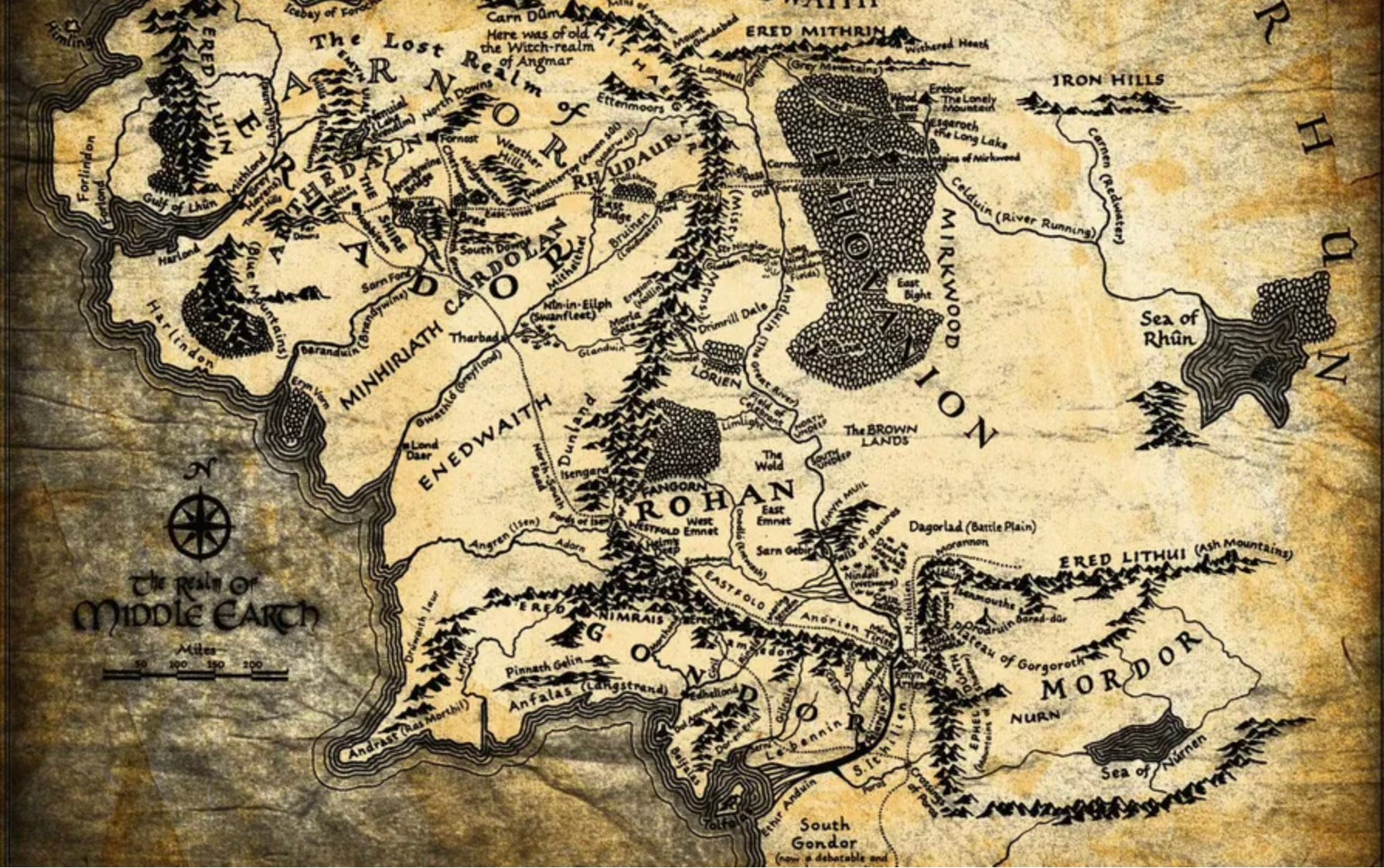 Map of Middle Earth: https://wallpapers.com/wallpapers/middle-earth-map-lotr-yx9t3d12pic3ibsk.html
A Modern History Lesson: Case Studies in Redefining Who “I Am”
The African philosophical concept of Ubuntu (“I am because we are”),(1) the Korean philosophical concept of hanul (“the process of becoming together”),(2) and the First Nations philosophy of “all my relations” (or interconnectedness)(3) are just a few examples of a widespread understanding: the self is defined in connection to others.
But this extends beyond social relationships into spiritual ones as well.
The idea that a human being is part of God or Truth—and that divinity is therefore a core element of identity—appears in concepts such as atman (Hinduism), Imago Dei (Christianity), and pratītyasamutpāda or “interdependence” (Buddhism)(4) to name just a few.
In short, outside of modern Western individualistic and scientific thought, the idea of a self existing apart from relationship (whether human or divine) simply did not make sense.
This should tell us something about what it means to “be” a species called homo sapiens. Beyond being social animals, the human self exists within connection to other selves. The question, then, is what happens when we attempt to sever that connection in order to redefine who “I am”?
Previous Saturn–Neptune conjunctions in Aries offer some revealing glimpses.
91 BCE: Redefining Legal Identity
For centuries, Rome allied with Italian communities to gain soldiers, tribute, and allegiance. However, these socii were not citizens, and Roman citizenship determined legal personhood and rights within the state.
After helping Rome dominate the Mediterranean, the socii demanded full citizenship. Rome not only denied the request but assassinated one of their leaders, Marcus Livius Drusus, to maintain control.(5)
The socii responded by declaring their own state, sparking the Social War. Rome attempted to resist, but because the socii comprised the majority of its army, resistance proved futile. In 90 BCE, Lex Julia de civitate granted citizenship to most Italian communities—one of the largest expansions of political identity in antiquity.(6)
232 CE: Redefining Divine Identity
Origen of Alexandria was a Christian scholar, ascetic, and theologian whose ideas expanded what it meant to be human.
In On the First Principles and Contra Celsum, he proposed the preexistence of souls, universal restoration to the divine (including demons), and an allegorical reading of Scripture instead of a literal one. His theology centered on humans as fallen rational beings capable of divine ascent.(7)
Origen attracted intense criticism from Church authorities because his ideas destabilized the boundary between human and divine. He eventually died from injuries sustained during torture inflicted by the authorities. Yet his ideas lived on and resurfaced in the next Saturn–Neptune conjunction in Aries.
555 CE: Redefining Personhood
Justinian I pursued legal, theological, and imperial unity with near obsession. His Corpus Juris Civilis defined who qualified as a legal “person” and who could be treated as property. While it clarified distinctions between slavery and personhood, it also narrowed theological ambiguity.
In 553 CE, the Second Council of Constantinople confirmed Justinian’s condemnations of certain theological positions, including Origenism. This was a direct effort to regulate speculative theology and solidify a fixed definition of humanity’s spiritual nature in relation to God.
By 555, the Council had excommunicated, imprisoned, and strong-armed Pope Vigilius into signing off on their mandates.(8)
1380 CE: Redefining Access to Truth
John Wycliffe, theologian and philosopher, antagonized the Church, State, and University by criticizing ecclesiastical overreach. By 1380, his focus turned toward rejecting transubstantiation—the belief that the Eucharist literally becomes the body and blood of Christ.(9)
The Peasants’ Revolt of 1381–1382 followed soon after, fueled in part by his teachings. At its core were issues of taxation, inequality, and hierarchical definitions of human worth. Wycliffe also emphasized direct lay access to Scripture and divine truth.
Though he avoided excommunication during his lifetime, his followers—the Lollards—were later executed. Thirty years after his death, the Church excommunicated Wycliffe posthumously, exhumed his bones, and burned them.
1703 CE: Redefining Consciousness
John Locke argued in An Essay Concerning Human Understanding that the mind is a blank slate (tabula rasa) and that knowledge derives from experience. Identity, therefore, rests on the continuity of awareness. Locke also advanced theories of self-ownership and property, asserting that labor transforms objects into personal property rather than property being granted by monarchs.(10)
However, his work also posthumously contributed to the justification of slavery and exclusion from civic participation. This fueled European debates about the rationality of Indigenous peoples and the rights of enslaved Africans.
In response, Gottfried Leibniz composed New Essays on Human Understanding in 1703 and later Monadology, challenging Locke’s empiricism. Leibniz argued that experience activates what is already latent within the human being.(11) His metaphysics also proposed that animals possess perception, suggesting a continuum of consciousness.
This empiricist–rationalist debate echoes into the present AI Revolution.

Redefining Autonomy and Attachment
In each of these Saturn–Neptune in Aries moments, important written works challenged the boundary of who counts as a person and who defines that boundary. Some expanded identity and others narrowed it in the name of unity or control. All were attempts to negotiate identity within relationships: to the self, each other, and to God.
As we saw in Part One and Part Two of this series, these historical examples are dynamically relevant to defining boundaries in relationships to the self in today’s AI Revolution. These examples also provide a useful bridge to psychological concepts that illuminate our current process of redefining identity with each other and to the Divine: attachment, codependency, autonomy, and differentiation.
Every relationship involves attachment. Too much becomes codependency; too little becomes detachment or extreme autonomy. The middle ground is differentiation.
Differentiation is a lifelong process of defining a unique sense of self while maintaining emotional connection to others. It is both the antidote to codependency and the fertilizer for intimacy.
Healthy differentiation means that when I express ideas, needs, or desires that differ from yours, I am not threatened with abandonment or shame. The difference is tolerated (perhaps even welcomed) and the relationship survives.
Differentiation also means that I do not require isolation in order to maintain authenticity or a separate sense of self. Excessive autonomy breeds detachment and undermines belonging.
These concepts remind us that relationships are the crucible of identity. To relate is to encounter difference and conflict. In that crucible, parts of you are burned away and parts are forged.
Avoiding relationships altogether is an illusion of safety and distance. Saying, “I am separating myself from you” still positions oneself in proximity to the other—it does not make them cease to exist.
The inverse of this illusion in modern Western culture is “ghosting”—pretending that “I don’t exist so you can’t connect with me.”
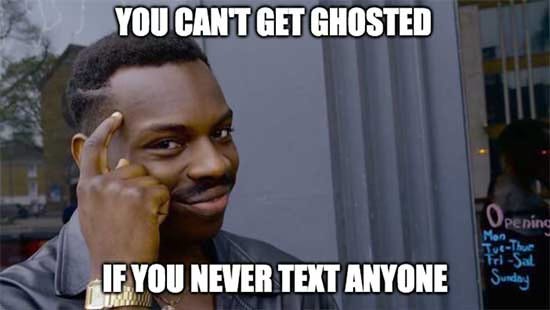
You cannot deny the other without acknowledging the existence of an other and in the process, relate to the other.
For example, Nietzsche’s declaration that “God is dead” presupposes an ‘other’ called God. A person’s refusal to believe in a God may create relational distance, but not ontological annihilation. Thus, even nihilism—the belief that ultimate meaning and knowledge are not possible—affirms a relationship to higher purpose or Truth. If there is no Truth, there is nothing by which nihilism could define or contrast itself.
In every-day-speak, when we refuse to “see” the other—by denying personhood, citizenship, divinity, access to Truth, or consciousness—we are evading relationships, not causing them to cease to exist. In actuality, to evade relationships is to avoid conflict, responsibility, and differentiation, and this tactic usually stems from an insecure identity.
These evasions are rarely philosophical ideas though. They are rooted in personal beliefs picked up like souvenirs during our adventures in relationships. For example:
I believe no one will stay if I express my needs, so I’ll just go-along to avoid rejection.
I believe I am fundamentally flawed, so I’ll withhold my authentic self to avoid being seen and shamed.
I believe I’ll be consumed if I’m in a relationship, so I’ll just avoid intimacy altogether.
Conflict, authenticity, and differentiation can feel like standing naked in a town square. It is no surprise we spend much of our lives avoiding them. Yet they are essential to meaningful relationships and to defining what it means “to be” me.
Removing the Blindfold
This Saturn–Neptune conjunction in Aries asks us to redefine who “I am” without swinging between isolation or codependency. Differentiation and authenticity do not deny the existence of the other, but they are not achieved in a single decision either. They are kind of more like verbs than nouns.
Brene Brown, the authenticity expert, says in The Gifts of Imperfection(12):
“Like many desirable ways of being, authenticity is not something that we either have or don’t have. It’s a practice. It’s a conscious choice of how we want to live. Authenticity is a collection of choices that we have to make every single day. It’s about a choice to show up and be real, a choice to be honest, a choice to let our true selves be seen. Authenticity is this: it’s the daily practice of letting go of who we think we’re supposed to be and embracing who we are. It’s cultivating and choosing the courage to be imperfect, to set boundaries, and to allow ourselves to be vulnerable.”
Redefining what homo sapiens are or who “I am” is neither a declaration of total autonomy, nor a system setting or prompt fed into an LLM. Authentic identity is not programmable. It is a lived process—daily decisions—about how we relate to the Earth, to others, to ourselves, and to the Divine.
Throughout this series, I suggested that instead of asking when AI becomes conscious, we should ask when we become unconscious. Saturn-Neptune in Aries suggests that consciousness means applying creativity, moving from dissociation toward feeling, and acknowledging our relationships to the Earth, to each other, and to Truth.
Consciousness is an ongoing process of authenticity and differentiation, which means the path is not chosen once. It is chosen daily.
Which also means, it’s not too late to turn left, Frodo.
Cover Art from Unsplash: ashkan-forouzani-m0l9NBCivuk-unsplash.jpg
Footnotes:
References:
AI Priest Chat. (2026, February 22). The Holy Trinity. https://e-catholic.org/ai-priest-chat/
African philosophy. (2026, February 23). Wikipedia. https://en.wikipedia.org/wiki/African_philosophy
Anthropic and Claude. (2026, February 4). How can I communicate better with my mom? [Video]. YouTube.
Badian, E. (2024, February 28). Marcus Livius Drusus. Encyclopedia Britannica. https://www.britannica.com/biography/Marcus-Livius-Drusus-Roman-tribune-died-91-BCE
Baigent, M. (1994). Astrology in ancient Mesopotamia: The science of omens and the knowledge of the heavens. Bear & Company.
Bhagavad Gita. Chapter 11, Verse 32. https://www.bhagavad-gita.org/index-english.html
Brown, B. (2010). The gifts of imperfection: Let go of who you think you’re supposed to be and embrace who you are. Hazelden.
Campion, N. (2008). A history of western astrology, volume I: The ancient and classical worlds. Bloomsbury Academic.
Cartwright, M. (2023, March 20). Top ten inventions of the Industrial Revolution. World History Encyclopedia. https://www.worldhistory.org/article/2204/top-10-inventions-of-the-industrial-revolution/
Chadwick, H. (1966). Early Christian thought and the classical tradition: Studies in Justin Clement, and Origen. Oxford University Press.
Couderc, B. (2025). Transhumanism: Towards a new Adam? Ethics, Medicine and Public Health, 33, 101091. https://doi.org/10.1016/j.jemep.2025.101091
CupidAI. (2026, February 22). Dataing Inc.
https://dataing.io/
deMenocal, P.B. & Tierney, J.E. (2012). Green Sahara: African humid periods paced by Earth’s orbital changes. Nature Education, 3(10), 12. https://www.nature.com/scitable/knowledge/library/green-sahara-african-humid-periods-paced-by-82884405/
Forrest, S. (2014, October 17). Neptune in Pisces timeline. Forrest Astrology. https://www.forrestastrology.com/blogs/astrology/neptune-in-pisces-timeline
Great Year. (2026, February 17). Wikipedia. https://en.wikipedia.org/wiki/Great_Year
Hayes, L. (2025, September 6). Neptune, Uranus, and the US at war. https://www.lynnhayes.com/neptune-uranus-and-the-us-at-war/
Hendrickson, R. (2025, November 2). The myth of compatibility: Why great marriages are built, not found. Align Couples Therapy. https://www.krista-j-miller.com/blog/2025/11/2/the-myth-of-compatibility-why-great-marriages-are-built-not-found#:~:text=Compatibility%20isn’t%20what%20keeps%20couples,Gottman’s%20research%20backs%20this%20up.
Hoopes, T. (2024, April 30). AI priest Fr. Justin absolved sinners and ‘served God.’ How did this happen? Benedictine College.https://media.benedictine.edu/ai-priest-fr-justin-abolved-sinners-how-did-this-happen
Interconnectedness. (2026, February 23). First Nations Pedagogy Online. https://firstnationspedagogy.ca/interconnect.html
John Wycliffe. (2026, February 22). Wikipedia. https://en.wikipedia.org/wiki/John_Wycliffe
Johns Hopkins Center for a Livable Future. (n.d.) History of agriculture. Food system primer. https://foodsystemprimer.org/production/history-of-agriculture
JPL DE431 Ephemeris: -13000 BC to +17000 AD. (2026, February 18). AstroSeek. https://horoscopes.astro-seek.com/calculate-jpl-de431-ephemeris-tables/?de431=1&narozeni_rok=-8128&table=long_roky&jupiter_s=&saturn_s=&uran_s=&neptun_s=&pluto_s=&uzel_s=
Lex Julia. (2026, February 22). Wikipedia. https://en.wikipedia.org/wiki/Lex_Julia
Magisterium. (2026, February 22).
https://www.magisterium.com/
McCrae, M. (2025, October 3). Scientists found an entirely new way to measure time. Science Alert. https://www.sciencealert.com/scientists-found-an-entirely-new-way-to-measure-time
Moltbook. (2026, January 28). A social network for AI agents.
https://www.moltbook.com/
Oh, J. S. (2026, March 12). Divine Omnipresence through Inter-Becoming: Process Panentheism and the Cosmology of Eastern Learning (Donghak, 東學)[Guest Speaker]. The PCC Forum, Philosophy, Cosmology, and Consciousness Department — CIIS, San Francisco, California.
Philopedia. (2026). New essays on human understanding. Philopedia. https://philopedia.com/works/new-essays-on-human-understanding/
Pratītyasamutpāda. (2026, February 22). Wikipedia. https://en.wikipedia.org/wiki/Prat%C4%ABtyasamutp%C4%81da
Raphael, R. (2017, November 6). Netflix CEO Reed Hastings: Sleep is our competition. Fast Company. https://www.fastcompany.com/40491939/netflix-ceo-reed-hastings-sleep-is-our-competition
Rogers, G.A. (2023, February 22). An Essay Concerning Human Understanding. Encyclopedia Britannica. https://www.britannica.com/topic/Essay-Concerning-Human-Understanding
Second Council of Constantinople. (2026, February 22). Wikipedia. https://en.wikipedia.org/wiki/Second_Council_of_Constantinople
The Ethics Centre. (2018, February 22). What is post-humanism? - Ethics explainer. https://ethics.org.au/ethics-explainer-post-humanism/
There is no Planet B. (2026, February 19). Wiktionary. https://en.wiktionary.org/wiki/there_is_no_Planet_B