I would like to say something that may draw rotten eggs and sour cabbage from both sides of the aisle: astrology—in its technical study of planetary cycles—neither does anything to us nor orchestrates anything any more than a clock controls or orchestrates time. (Here I am referring to astrology as a systematic study of planetary cycles rather than its divinatory traditions.)
However, it does describe and reflect an underlying organizing principle which appears in science as much as it does in the metaphysical.
This is one of the reasons why I don’t think that using chart-based predictions in scientific experiments is the best approach to reunite science and astrology. We need to zoom out—way further out in fact, in order to see why astrology, science, and even our engagement with the Divine are all cut from the same cloth.
The point I’d like to make is that astrology in itself is not the point, in as much as scientific innovation and political theory are not the point. But they are all describing the same thing, albeit with their own language: reality appears to organize itself through recurring patterns that correspond to measured increments of time.
To explore this idea, I’d like to offer a series of articles for consideration (likely spread out over time as I do more research) that show parallels across fields that point to this underlying pattern. So, while this series will begin with a particular planetary cycle and set of scientific and academic principles, the goal will be a kind of mixed methods approach conducted over time, with both quantitative and qualitative data.
If at the end of this experiment you would still like to throw your chosen vegetable, that is your choice. Though I hope the exchange won’t be ‘the same old garbage’ and will instead turn this conversation on its head.
To start, we need to first consider what I mean by an underlying organizing principle, and to that, we first turn to science.
Different Fields, Same Principle
Philosophers of science call an observation that appears in multiple domains a cross-domain isomorphism. In layman’s terms, a cross-domain isomorphism is when different fields or systems with different vocabularies share the same underlying structural pattern despite using different vocabularies. For example, galaxies, hurricanes, nautilus shells, and sunflowers all exhibit the same underlying spiral form. The spiral pattern is recognized as transcending these individual domains.

However, let’s say that these independent fields all start to produce independent evidence that this spiral emerges under certain growth constraints. Now you have consilience.
William Whewell coined the term a “consilience” of evidence, which, simply put, means independent lines of evidence converging to form the same conclusion. While a consilience doesn’t “prove” a theory, it is considered one of the strongest forms of scientific support.
For example, evolution is supported by independent experiments and analysis in genetics, paleontology, embryology, geology, etc., which together form a consilience of evidence. This convergence increases the confidence that a theory or principle—in this case, evolution—reflects something real rather than being an artifact of one field in particular.
The reason a cross-domain isomorphism and a resulting consilience of evidence is so important, is that they contribute to several criteria that scientists use to evaluate theories, including:
Explanatory power: It explains many observations within a single framework. For example, Newton’s law of gravity explained falling apples, planetary motion, and tides.
Generalizability: It applies beyond the original concept and into other domains.
Robustness: Different methods (i.e. qualitative interviews, historical case studies, statistical analysis, etc.) arrive at the same conclusion, which increases confidence. Replicating results helps eliminate the influence of errors or circumstantial factors.
Predictive validity: If the organizing principle is truly fundamental, then we should be able to observe it in domain xeven though no one has looked there before. Finding it where predicted is much stronger than finding similarities after the fact.
An example from the history of science is network theory. It’s used in neuroscience, epidemiology, computer science, sociology, economics, ecology, and other fields. The fact that similar mathematical structures describe neural networks, airline routes, food webs, and social media does not “prove” network theory. Rather, it suggests that networks are a fundamental organizational pattern that appears across many kinds of systems. The theory became compelling because it successfully modeled diverse phenomena across different fields and generated new predictions that were repeatedly confirmed.

Consilience as an Example of a Meta-consilience
Not to get too “meta” on you, but we can actually take a step back and see that a cross-domain isomorphism or a consilience is itself only one example or one independent line of inquiry of this same idea in other fields with their own vocabularies. I’ll give you two examples.
Firstly, the term structural homology originated within the field of evolutionary biology but it is widely used in mathematics and physics, chemistry and material sciences, and sociology and linguistics. It describes systems that share the same underlying structure or mathematical framework despite looking different on the surface. The clearest and most famous example of structural homology is the pentadactyl (five-digit) forelimb framework found in vertebrates, which includes humans, bats, whales, and cats. This is the same idea as a cross-domain isomorphism.
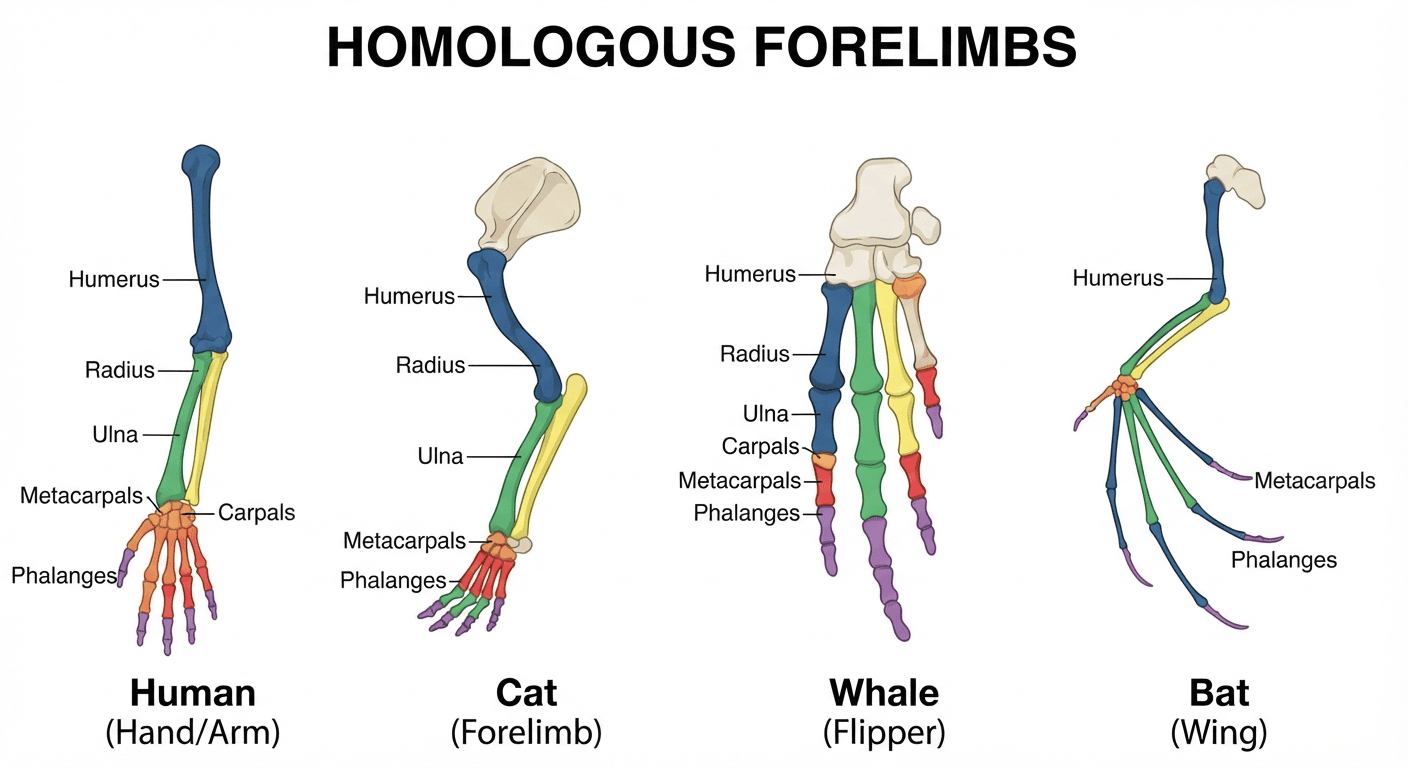
Image generated by AI
Secondly, sufficient weight of evidence within the legal system refers to when coincidences continue to pile up and combine with explanatory power, presenting a very strong plausibility argument or even a proof. A famous example of this type of “consilience of evidence” in the US is the 2004 Scott Peterson murder trial. There were no eyewitnesses, confessions, video evidence, or murder weapons. However, the prosecution built sufficient weight of evidence (i.e. he was having an affair, lied about it, told his girlfriend he was widowed before his wife disappeared, had gone fishing in the bay where the bodies were found, etc.) which showed that while individually each point could have an innocent explanation, cumulatively the facts became extraordinarily unlikely to be coincidental and came to form a proof or at least collectively compelling evidence of underlying guilt.
As you can see, what we’re really describing here is that when the same principle shows up across domains it is given a particular name (such as consilience). However, these named principles (such as consilience and sufficient weight of evidence) are themselves examples of a larger organizing principle that touches on the patterning of reality and existence. I’ll make a suggestion of what to call that so we’re all on the same page.

A Case for Cyclical Time
Let’s start with a question: What is this cross-domain isomorphism and consilience that I am describing here?
Some organizing principles are spatial (such as, spirals, networks, and branching systems). Other principles are less tangible and more experiential, and my claim is that cyclical time belongs in this second, temporal category. It is an underlying structure (i.e. cross-domain isomorphism) that appears independently across multiple domains. Astrology happens to describe it through planetary cycles; however, other fields such as the philosophy of science, political theory, and theology, also describe it through their own languages and vocabularies.
If these different fields arrive at the same analogous model of time as structured, patterned, and recurrent, then the cumulative evidence begins to converge around the same explanatory principle (i.e. consilience). This recurring organization around cyclical time includes developmental stages, feedback loops, and other oscillating factors. At the same time, these patterns still leave room for novelty and independent choices (what I’ll loosely call free will for short), while still maintaining a larger meta-cycle or structure of time that produces the same archetypal experience predictably (what I’ll loosely call fate for short).
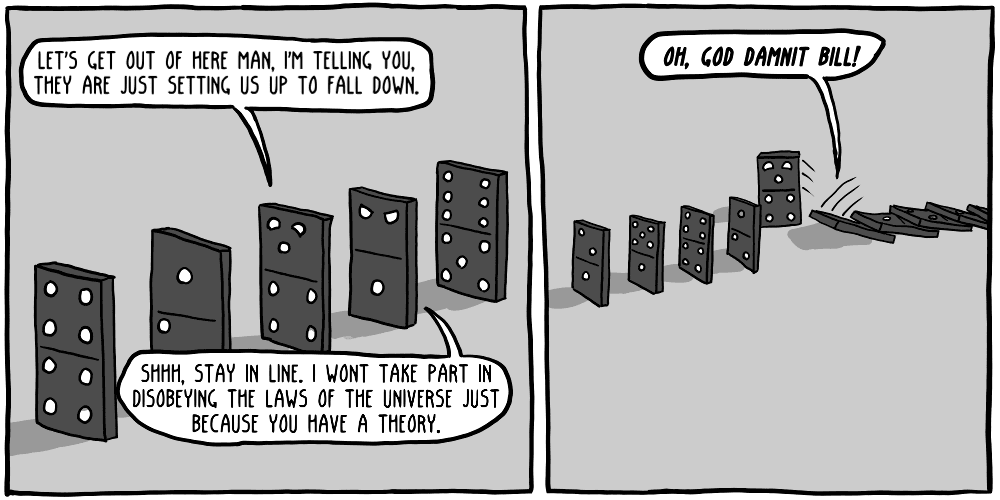
https://vusf.wordpress.com/2019/03/27/free-will-vs-fate/
While Substack is not an academic journal, my intent is to use a kind of mixed methods approach to test and develop this theory, identify historical cases, code qualitative themes where necessary, quantify frequencies or relationships, and possibly even test predictions on cases not yet explored to build the model.
For those of you not into obtuse wording and lofty concepts, I hope my previous articles show that I try to make my content closer to the town square below as opposed to the ivory tower up above. That said, it’s a lot of stairs between the square and the top of the tower, so if I seem a little “winded” at times, this is why.
I don’t claim to be a scientist and I am sure that there will be things learned along the way. Hopefully I’ll at least get a few ‘Personal Bests’ out of the stair reps. Plus, there will certainly be other topics in-between as this is an ongoing inquiry.
However, I am a researcher, astrologer, philosophical and theological history-seeker with enough curiosity to see where this goes. Of course, if there are any theories or cycles that any of you are aware of that you think I should take a look at, I welcome the data!
I’ll kick off this truly unusual line of inquiry with an á propos starting point, and that’s the planetary cycle of Uranus.
References:
Elsevier. (n.d.). Structural homology. ScienceDirect Topics. https://www.sciencedirect.com/topics/immunology-and-microbiology/structural-homology
HandWiki. (2022, October 10). Homology. In Encyclopedia. https://encyclopedia.pub/entry/28634
William Whewell. (2026 May 23). In Wikipedia. https://en.wikipedia.org/w/index.php?title=William_Whewell&oldid=1355735648
Zhou, H., & Jia, G. (2026). Mechanism-centric cross-domain retrieval for scientific discovery: LLM agents for structural isomorphism beyond semantic similarity. SSRN. https://papers.ssrn.com/sol3/papers.cfm?abstract_id=6329666